The Paradigm Shift: Buoyancy as a Modern Addition to the Chain of Survival

The third link in the Drowning Chain of Survival – Provide Flotation – is one of the most important developments in modern water rescue. For decades, rescue strategies focused almost exclusively on getting a person out of the water as quickly as possible. International water rescue research now shows something different: early buoyancy changes the course of a drowning event decisively. Adding this step to the Drowning Chain of Survival wasn't an organizational detail, it was a physiologically grounded shift. Survival odds rise significantly when the progressing oxygen deficit is interrupted before a person goes fully under or suffers a hypoxic cardiac arrest.
Why the Body Tires So Quickly in Water
Swimming is one of the most demanding forms of human locomotion, even under controlled conditions. Unlike walking or running, the body doesn't just need to generate forward motion – it also has to constantly control its own buoyancy and keep the airway above the surface. Nearly every major muscle group works at once, while breathing effort rises sharply, since inhalation is only possible in short windows above the waterline.

Why Panic Makes Oxygen Deprivation Worse When Drowning
In an emergency, this strain shifts dramatically. Fear and panic put the body on high alert within seconds: stress hormones like adrenaline are released, the heart beats faster, blood pressure rises, and breathing becomes erratic. This briefly boosts performance, but it also makes the body consume significantly more oxygen. Exercise physiology research shows that psychological stress alone can noticeably raise oxygen demand. This is exactly the problem in drowning: the body is already short on oxygen, and panic makes it need even more. Oxygen demand and oxygen supply pull further apart, and the deficit deepens.
At the same time, movement efficiency – how efficiently the swimming stroke moves the body – declines. As exhaustion grows, stroke length shortens, drag increases, and the energy cost per meter rises. This drop in movement efficiency is well documented in sports science and is especially pronounced under emergency conditions. The person has to expend ever more energy just to hold the same position at the surface. Meanwhile, lifting the head clear of the water becomes harder, the mouth and nose go under more often, each breath becomes more difficult and the oxygen deficit deepens further.
Archimedes' Principle: How Buoyancy Can Lower Energy Expenditure
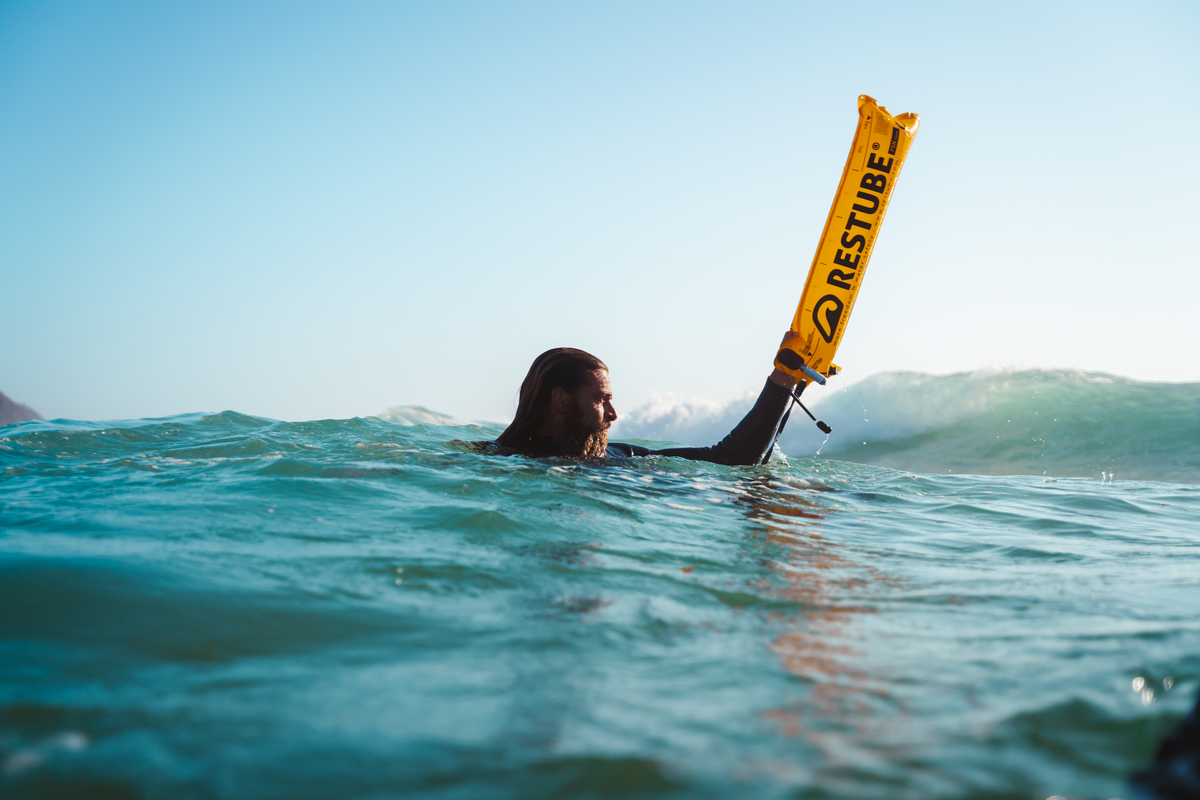
This is exactly where added buoyancy makes the difference. Physically, the effect of buoyancy rests on Archimedes' principle: an object in water experiences an upward force equal to the weight of the water it displaces. When the body no longer has to generate that buoyancy through muscle work alone, energy expenditure drops noticeably. The person can keep their airway above water with far less physical effort, freeing up more of their remaining energy reserves for controlled breathing and clear thinking. What matters most isn't the absolute size of the added buoyant force, but the fact that it interrupts the constant fight against sinking. Even modest extra buoyancy can significantly lower energy expenditure and extend the time someone stays able to act.

Experimental studies confirm it – even small improvements in body position in the water measurably lower oxygen consumption, because less muscular effort is needed for stabilization and the mouth and nose stay above the surface more often.
Buoyancy doesn't just work mechanically; it affects several physiological systems at once, lowering muscular strain, improving breathing, reducing oxygen demand, and delaying critical hypoxia – the life-threatening lack of oxygen.
Why Buoyancy Breaks the Panic-Exhaustion Cycle
Exhaustion and panic reinforce each other: the more exhausted someone is, the more threatening the situation feels – and fear, in turn, raises muscle tension, breathing rate, and uncoordinated movement. Added buoyancy can break this cycle early: once someone realizes they aren't going under, their stress response often eases, breathing and muscle tension partially normalize, and oxygen consumption drops. Buoyancy protects not just biomechanically, but psychophysiologically too.
This matters clinically: most drowning events unfold over several minutes, not seconds. Within that window, the outcome can still be changed. If a person can be stabilized at the surface, the odds rise significantly that help arrives in time or a safe rescue succeeds. The Drowning Chain of Survival deliberately doesn't aim to get every person out of the water immediately, it aims first to stop the drowning process. The actual rescue follows after that.

Buoyancy Protects Rescuers Too
Buoyancy doesn't only protect the person in distress. Every year, would-be rescuers drown during spontaneous rescue attempts – usually through direct physical contact with a panicking person. Under oxygen deprivation, people in distress often instinctively grab onto their rescuer with great force, causing both to lose the ability to swim and go under together. The International Life Saving Federation therefore recommends providing a flotation device first whenever possible, and avoiding direct physical contact. Added buoyancy stabilizes the person in distress and reduces their instinct to cling to the rescuer. Providing flotation is therefore also a core part of a rescuer's own self-protection. Wanna learn more about safe water rescue? Check out Step 4 of the Drowning Chain of Survival: Remove from water.
Conclusion: Buoyancy Is More Than a Floating Object
The significance of this third link goes far beyond a buoyant object. It's an evidence-based measure that works simultaneously on a physical, physiological, psychological, and rescue-tactical level:
- Lowers energy expenditure
- Improves breathing
- Breaks the cycle of panic and exhaustion
- Extends the time until critical hypoxia
- Increases safety for everyone involved
This combination explains why providing flotation is now considered a link in its own right in the Drowning Chain of Survival, carrying the same weight as rescue and medical care.