Why Removing Someone from the Water Comes After Providing Flotation

The fourth link in the Drowning Chain of Survival – Remove from Water – describes safely bringing a person out of the water. For many people, this feels like where a water rescue actually begins, but within the chain of survival, this step deliberately comes after buoyancy has already been provided. The reason: immediate removal isn't automatically the safest or most effective action. The priority first is to prevent the person's condition from getting worse, or additional people from being put at risk. Modern water rescue stabilizes the drowning process first and rescues afterward - with maximum attention to the rescuer's own safety.
Why Self-Protection Is Essential in Water Rescue
Historically, rescue approaches were often shaped by the understandable instinct to pull a person out of the water as fast as possible. Numerous accident analyses show, however, that this spontaneous impulse can itself carry significant risk. Every year, not only drowning victims die worldwide, but also would-be rescuers who try to pull someone directly from the water without proper equipment or training. Rescuer fatalities – deaths that occur during rescue attempts – can account for a meaningful share of all fatal water incidents in many countries. These are especially often family members, friends, or bystanders who jump in immediately out of understandable concern, and end up in life-threatening danger themselves.
According to the RESTUBE Safety Study 2026, only 47% of respondents said they know for certain what to do in an emergency.
Water rescue medicine therefore treats protecting the rescuer as a non-negotiable precondition for any successful rescue.

Why Drowning People Cling to Their Rescuers
As oxygen deprivation and fear progress, higher cognitive function becomes increasingly impaired, while instinctive survival behavior takes over motor control, the same Instinctive Drowning Response that also makes it so hard to recognize someone is in distress. A person moments from going under stops acting purposefully and instead instinctively grabs onto anything available to get their airway above water. This reflexive clinging isn't a conscious decision – it's an automatic protective program built into the human nervous system. If a rescuer makes direct physical contact without a distance aid, there's a significant risk that the person in distress will grab onto them, and both will go under together.
Reach – Throw – Wade – Row – Go: The Staged Model of Safe Water Rescue
Given this, international water rescue organizations developed a staged model that systematically minimizes the rescuer's own risk:

It varies slightly by organization, but always follows the same logic: rescue without direct physical contact and without leaving a safe position, whenever possible. Only when one stage isn't viable does the next, riskier stage come into play.
-
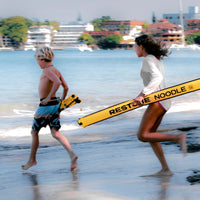
Reach – rescuing without entering the water. The rescuer stays on land or on a stable platform and reaches the person with a pole, branch, paddle, or rescue pole. This minimizes the rescuer's own risk, since their center of gravity stays out of the water, and lets the person (if they still have some strength) actively help. The physical effort is shared between both people, while the risk of uncontrolled physical contact is reduced. Reach rescues are among the safest and most successful methods, as long as the distance is short enough.
-
Throw – life rings, buoys, and throw bags as distance rescue tools. If direct reach isn't possible, a life ring, rescue buoy, throw bag, or other buoyant object is thrown to the person. This serves two purposes at once: it stabilizes the drowning process through buoyancy and extends the window of time until help arrives, and it maintains physical distance between rescuer and the person in distress, significantly lowering the risk of a secondary emergency. This dual protective function explains why throw rescues hold such a high place in modern rescue approaches.
-
Wade – controlled approach in shallow water. If Reach and Throw aren't promising options, a controlled approach through shallow water may be appropriate – provided the ground is safe to walk on and there's no current or surf. The rescuer must maintain solid footing at all times and be able to retreat immediately. Here too, a distance aid should still be used whenever possible to avoid direct physical contact. This ability to retreat at any moment is exactly what distinguishes wading from a full swimming rescue.
-
Row – rescue by boat. Boats or other watercraft offer clear advantages in open water, on lakes, or along coastlines: faster approach, a stable platform, room for additional rescue equipment, and the ability to prepare medical care in advance. Modern water rescue increasingly uses motorized rescue boats or rescue watercraft (motorized, jet-ski-based rescue vehicles). Here too, the goal remains to avoid direct physical contact and provide buoyancy first.
-
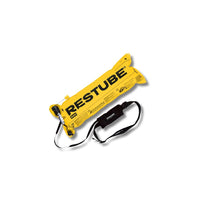
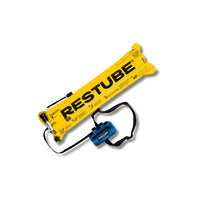
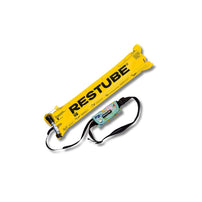
Go – but with a rescue aid. A direct swimming rescue is the final and riskiest stage, used only when no other option remains. Even trained lifeguards avoid swimming out without a rescue aid whenever possible: rescue buoys or rescue tubes create distance, prevent uncontrolled clinging, and allow for controlled stabilization until the actual recovery. International training standards therefore explicitly treat an unassisted swimming rescue as a last resort.
Important: The right method depends heavily on the environment. Rivers, surf zones, floodwater, or cold water each place different demands on the rescuer. Even modest current speeds exert considerable force and can sweep both rescuer and the person in distress off course. Waves, poor visibility, or darkness make orientation even harder. Modern water rescue treats assessing these environmental factors as a core part of every rescue decision, not just a tactical afterthought.

Why Rescuers Tend to Act Too Fast: The Action Bias
From a human factors research perspective, helpers in acute emergencies tend toward what's known as Action Bias: the psychological tendency to act visibly and immediately rather than choose the safest strategy. In water rescue, this often shows up as people spontaneously jumping into the water even when safer alternatives are available. Training and regular practice aim to replace this intuitive behavior with structured decision-making. Consistently applying the Reach – Throw – Wade – Row – Go principle has been shown to reduce the rescuer's own risk while also increasing the likelihood of a successful rescue.
Conclusion: Safe Water Rescue Is More Than Just Swimming
The significance of this fourth link in the Drowning Chain of Survival goes well beyond simply pulling someone from the water. Removing someone from the water is a structured decision-making process that combines medical, physical, psychological, and rescue-tactical knowledge. The actual rescue doesn't begin with jumping into the water – it begins with choosing the safest, and simultaneously most effective, rescue strategy. Only when both the person in distress and the rescuer are protected can the chain of survival continue successfully into the medical care that follows.
















 Swimming
 Surfing
 Kitesurfing
 Stand Up Paddling
 Windsurfing
 Casual beach days
 On board
 Snorkeling
 Rowing
 Canoeing & Kayaking
 Fishing
 Professional Rescue
 Stream/Creek
 River
River
 Canal
Canal
 Sea
Sea
 Swimming Pool
 Lake
Lake
 Pond
Pond


