How Eddies and Suction Currents Form
Unlike open currents that spread over larger areas and are visually readable, these phenomena act in concentrated, localised ways. They form whenever water is forced through narrow passages, over edges, or must equalise pressure differences. This creates complex current patterns in which water moves not only horizontally, but also vertically.
A typical example are lock systems. When their gates open or close, the water accelerates rapidly and powerful currents develop. Close to these structures, a suction effect can pull water with great force toward an opening. People in this area can be caught in this current before they even realize it - and once in it, the force is strong enough to make it nearly impossible to break free.

Similar processes occur at weirs. There, water flows over an edge into a lower basin. While the main flow is visibly directed forward, complex backflows and vertical circulations develop beneath and beside it. Particularly dangerous are zones where water is pulled downward before rising again. These vertical movements can push people underwater even when the surface appears relatively calm.

Eddies frequently form in these transition zones. They are the expression of rotating currents in which water is drawn spirally downward. Unlike dramatic depictions, most eddies in inland waters are not visibly large. They are often smaller but powerful rotational movements that are sufficient enough to destabilise a person in the water.
Why Eddies and Suction Currents Are So Dangerous
What makes these phenomena so dangerous is their invisibility and localised nature. While large-scale currents are often detectable through waves or surface movement, suction currents and eddies frequently act below the visible surface. An area can appear calm while powerful forces are at work just a few meters away or beneath.
A further critical factor is the proximity to fixed structures. Unlike open water, there is the additional danger of being pressed against structures or becoming entangled in obstacles while being held underwater by the current. The combination of directed flow and fixed objects significantly increases the risk.
By comparison, classic hydraulic rollers or so-called "surges" are actually rarer in many German rivers, or confined to specific areas. The everyday danger lies rather in the inconspicuous but powerful current phenomena at man-made structures - occurring regularly, hard to detect, and therefore frequently underestimated.
Identifying and Avoiding High-Risk Zones in Rivers
In practice, this means: areas around locks, weirs, and other hydraulic structures should always be treated as high-risk zones. The most important safety factor here is distance. Anyone approaching these structures enters a current system that acts not only horizontally but also vertically, making it significantly harder to control.
"The greatest danger in a river often lies not in wild water, but in the seemingly calm area in front of or beside a structure - where water is forced to reorganise itself, generating forces that are barely visible to the human eye but highly effective." ~ Christopher Fuhrhop, Founder RESTUBE
Flash Floods in Rivers: The Danger of Weirs, Dams, and Heavy Rainfall
Even inland, water holds enormous dynamic potential. A calm river can change within seconds: when a weir is opened upstream, a dam releases water, or meltwater suddenly flows in after a storm.

![]()
These sudden surges of water arrive without warning and they can be life-threatening. The Ahr valley floods of July 2021 showed this in the most devastating way: the river rose so fast that many people had no chance to escape - over 130 lives were lost. An event that serves as a reminder, to this day, of how little time remains when the water comes.
Dangers of Flash Floods in Rivers
- Water levels rise abruptly.
- Currents become strong and unpredictable.
- Cold water rapidly causes cold shock and exhaustion.
- Undercurrents form at weirs, bridge pillars, locks, and large rocks.

Safety Rules for Flash Floods in Rivers
- Never enter the water directly below weirs or locks.
- Always follow warning signs and signals - sirens, flashing lights, red signs.
- Keep distance from outlets, pipes, and channels.
-
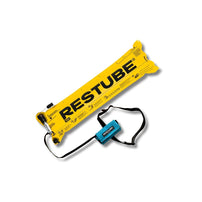
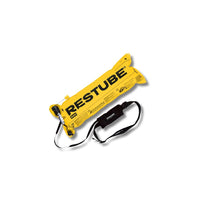
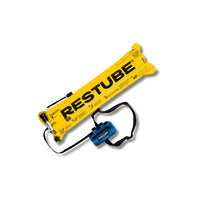
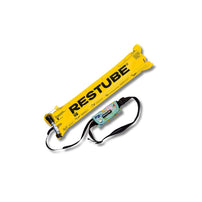
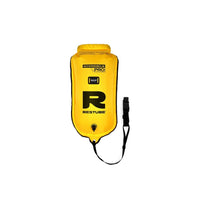
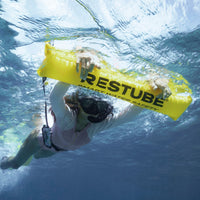
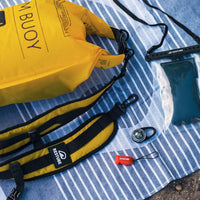
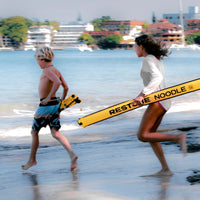
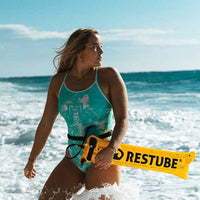
Always enter open water with a buoyancy aid (e.g. RESTUBE Safety Buoy) In fast-flowing water, a Predertimined Breaking Point can also be useful to prevent getting caught on obstacles.




























 Swimming
 Casual beach days
 Triathlon
 Stand Up Paddling
 Canoeing & Kayaking
 Rowing
 Motorboating
 On board
 Fishing
 Professional Rescue
 River
River
 Canal
Canal
 Stream/Creek
 Lake
Lake


