These numbers are not estimates. These are findings from the RESTUBE Water Safety Guide Study 2026 – a survey of 1,834 water sports enthusiasts across Germany, Austria and Switzerland (the DACH region). Some results are surprising – especially in the areas where you would expect safety awareness to be highest.
The Study: 1,834 Participants from the DACH Region
The study reached a broad, water-active audience. 82% of participants are from Germany, 13% from Austria, 5% from Switzerland. Nearly half spend time in, on or near water at least once a week. The gender split is roughly equal.
In terms of activities, swimming dominates – more than four in five respondents name it as their primary activity. Stand-up paddling, family trips to the water, snorkelling and boating follow close behind. Rivers, swimming pools and lakes top the list of preferred water environments.
Explore the full study with interactive data and charts on our Water Safety Guide Study 2026 page →
60% Have Experienced a Critical Situation in the Water – False Confidence Is the Real Risk
Almost 80% of respondents rate themselves as good or very good swimmers. More than two thirds say they feel safe in the water. You might expect this to be an experienced, well-informed group.
Then comes the figure that shifts the picture: 60% have already experienced a critical situation in the water – involving themselves or someone else. More than one in three rated that situation as life-threatening or at least very dangerous. One in five situations was classified as life-threatening.
The contradiction is clear: strong self-assessed swimming ability and a sense of safety in the water stand in direct contrast to the number of critical situations actually experienced. Physical exhaustion, unexpected currents, too great a distance from shore – these are not theoretical risks. They affect experienced and inexperienced swimmers alike.
People who have lived through it describe it more concretely. Of the 1,099 respondents who confirmed experiencing a critical situation, 949 shared details of their experience. The results are revealing – and in some places surprising.
Currents and waves top the list: 21% describe a situation in which currents or undertows became dangerous, and an equal share report being caught by waves or breakers. Both are physical forces that swimming ability alone cannot overcome. Anyone who has never been caught in a rip current or a breaking wave systematically underestimates how quickly control can be lost.
What is equally striking: in 20% of cases, the danger was not to the person themselves but to someone else – a child, a friend or a stranger. One in five of all described critical situations was a rescue attempt, not a personal near-drowning. The implication is clear: water rescue competence is not a specialist skill for professionals. It is knowledge for anyone who spends time near water.
Exhaustion and cramps (12%), boating and capsize incidents (10%), sudden weather changes (6%). The remaining 5% fall into other categories (see chart).
The Experience Paradox: More Skill, More Risk – But Not Always More Protection
Here is one of the key findings of this study: 38% of all respondents never use a buoyancy aid in the water. Only 16% always do. A look at other sports shows how quickly this can change. The ski helmet was once seen as excessive caution and met with scepticism. Today, over 90% of skiers in Germany voluntarily wear one – with no federal legal requirement, driven by education and cultural shift. Bicycle helmet usage in Germany nearly doubled between 2018 and 2023 – from 23% to 44% – again without any legal mandate. Buoyancy aids in water sports are still at the beginning of this curve. But the parallel is clear: what is the exception today can become the norm tomorrow.
73% of respondents who rate themselves as very good swimmers have already experienced a critical situation in the water – the highest rate of any ability group, significantly more than those who rate themselves as adequate swimmers (51%) or uncertain swimmers (62%).
What you might expect: this group protects itself least, believing it is invulnerable. The opposite is true. Very good swimmers are most likely to always wear a buoyancy aid (23%) – but simultaneously most likely to never wear one at all (24%).

Why do the most critical situations happen in this group? One explanation is that these individuals venture into more demanding waters: further out, in stronger winds, in rivers with currents, in the open sea. Pushing harder and approaching personal limits are likely contributing factors too. Risk increases not despite competence – but because of the confidence that comes with it. Those who have already experienced a critical situation may also be more inclined to wear protective equipment as a result.
Table 1 – Swimming Ability, Safety Equipment and Critical Situations
| Swimming ability (self-assessed) |
Buoyancy aid "Always" |
Buoyancy aid "Never" |
Critical situation experienced |
| Very good |
23% |
24% |
73% |
| Good |
14% |
42% |
56% |
| Adequate |
12% |
50% |
51% |
| Uncertain |
9% |
49% |
63%* |
Base: 1,834 respondents, RESTUBE Water Safety Guide Study 2026. *"Uncertain" group: n=43, interpret with caution.
The table makes the protection gap visible – and it sits in the middle. The "Good" group, with 931 respondents, is by far the largest in the study – more than half of all participants. They can swim longer distances, feel safe enough to venture into open water, and yet 42% never use a buoyancy aid. Only 14% always do. 56% have already experienced a critical situation.
Even more telling: people who rate themselves as only "adequate" swimmers – who are aware of their own limits – still carry no buoyancy aid in almost half of all cases. Awareness of personal limitations does not automatically translate into safer behaviour.
The real pattern here is not overconfidence among the most experienced. It is a lack of protection across all groups. Whether you swim well or adequately, critical situations occur – intended or not. Those who swim less confidently still go without protection. In an emergency, the result is the same: you are on your own.
The majority of critical situations described by participants were not caused by personal mistakes but by external factors – currents, strong waves, or another person in distress. In these moments, knowledge protects. Protective equipment complements it.
Risk Groups Compared: Who Protects Themselves – and Who Doesn't?
Young Adults: Most Active, Least Protected
The 18–29 age group stands out for a clear gap: almost half never use a buoyancy aid, and only around one in ten always does. The picture reverses with age – among those over 60, more than a quarter always wear a buoyancy aid.
The DLRG (German Life Saving Society) drowning statistics for 2025 show a rise in drownings among 11–30 year-olds: from 51 deaths in 2024 to 73 in 2025. This is a concerning signal – and it aligns directly with our study's finding: the youngest, most water-active group wears protective equipment least often. Drowning numbers are rising at the same time.
A further worrying trend in the DLRG statistics sits higher up the age pyramid. The 71+ age group accounts for the largest absolute number of drowning deaths – even though figures fell slightly last year. Older individuals are physically more vulnerable, tend to underestimate exhaustion and cold water, and are almost entirely absent from public water safety discussions. That needs to change.
SUP, Kayaking, Fishing: How Activity Shapes Safety Behaviour
Not all water sports enthusiasts behave the same way. Risk exposure, equipment standards and knowledge levels vary significantly depending on the activity.
Table 2 – Safety Behaviour by Water Activity
| Activity |
n |
Buoyancy aid "Always" |
Buoyancy aid "Never" |
Critical situation experienced |
Rescue measures known |
| Kayaking |
193 |
29% |
17% |
72% |
56% |
| Boating / Sailing |
345 |
21% |
23% |
70% |
58% |
| Diving / Scuba |
207 |
17% |
22% |
75% |
75% |
| Stand-Up Paddling |
626 |
20% |
28% |
62% |
48% |
| Fishing / Angling |
96 |
15% |
29% |
66% |
50% |
| Swimming |
1,526 |
14% |
41% |
60% |
48% |
Multiple responses possible. Base: 1,834 respondents, RESTUBE Water Safety Guide Study 2026.
Kayakers show the strongest safety behaviour – 29% always wear a buoyancy aid, only 17% never do. A well-developed safety culture in clubs and structured courses makes the difference.
Divers have the highest rate of critical incidents (75%), but also the best knowledge of rescue procedures (75%). Intensive, formal training leaves a lasting mark.
Anglers deserve particular attention. They are among the less visible water users – often alone, without a club context, on riverbanks with strong currents, sometimes after dark. 65% have experienced a critical situation, nearly half are at the water daily or weekly, and yet only a small proportion consistently wears protective equipment. Risk profile and safety behaviour don't match.
Swimmers form the largest group by far and have the lowest rate of consistent buoyancy aid use: 41% never wear one. It is precisely open water swimmers who most often underestimate currents, exhaustion and distance from shore.
Women and Men: A Moderate but Explainable Difference
A gender difference is visible in the data, but should not be overstated. When it comes to active buoyancy aid use – "always" or "sometimes" – men (49%) edge ahead of women (42%). Slightly more women (42%) than men (35%) report never using a buoyancy aid.
Part of this difference is explained by activity patterns: men in the sample are more frequently found in activities such as SUP, kayaking or boating – exactly the contexts where safety equipment is more culturally embedded. The difference is real, but less a question of gender than of activity.
Whilst there is little difference between men and women in the actual use of flotation aids, the figures for drowning show a much wider disparity: in 2025, 82% of those who drowned were male. The DLRG attributes this primarily to men’s greater willingness to take risks, alcohol consumption and a reduced awareness of danger.
Notably: when it comes to a possible legal requirement for safety equipment, women support this significantly more strongly. A sign that awareness exists – but hasn't yet fully translated into consistent action.
Drowning Statistics 2025: Where and When Drowning Accidents Happen in Germany
Lakes and Rivers: Three Quarters of All Drowning Deaths
146 of Germany's 393 drowning deaths in 2025 occurred in lakes, 136 in rivers. Together that accounts for over 70% of all fatalities – by far the most dangerous water environments in Germany from a drowning prevention perspective.
This aligns with how our respondents actually use water: rivers and lakes are the most common environments for water sports activities. No lifeguard, no barriers, often no other swimmers in sight – plus currents, shallow areas, algae and changing visibility conditions that simply don't exist in a swimming pool.
There is a striking disconnect between perception and reality. In our study, 80% of respondents identify the sea, currents and surf as risks in the water. Yet in the DLRG statistics, the open sea accounts for just 22 of Germany's 393 drowning deaths – less than 6% of all cases. A direct comparison of danger levels is not straightforward, since usage varies considerably: far more people in the DACH region spend time at lakes and rivers than at the coast. But the gap is clear: while the sea is perceived as especially dangerous, most fatal accidents happen in familiar environments – lakes and rivers. Knowing this lets you direct your water safety focus where it matters most.
The picture is different when it comes to causes: here, our respondents' experiences align with the DLRG data. Currents and waves – the two most commonly cited categories in personal accounts – are exactly the forces that prove fatal in lakes, rivers and coastal waters across the DACH region: river currents, underwater currents in bathing lakes, wave action on large inland waters and at sea.
Summer as Peak Season – But Water Doesn't Take a Break
In June 2025, 69 people drowned in Germany; in August, a further 65. The months of June through August account for 186 deaths – almost half of the entire year's toll, concentrating the risk into a short high-summer window.
Intuitive enough – more people are near water in summer. What is surprising: March (30) and November (22) also show significant numbers. Those who enter the water in cooler months often underestimate the changed conditions: colder water, faster onset of hypothermia, different current patterns.
Long-Term Trend: No Structural Improvement in Sight
In Germany, 393 people drowned in 2025 – 18 fewer than the previous year. A positive signal at first glance. The long-term curve puts it in perspective: after the pandemic low of 299 deaths in 2021, figures climbed back to 411 (2024) and 393 (2025). Before the pandemic, the figure stood at 419 (2019). The structural challenge has not diminished. (DLRG, Drowning Statistics 2025)
Regional differences are significant: Bavaria leads with 84 deaths, followed by North Rhine-Westphalia (48) and Lower Saxony (47) – three densely populated federal states with many natural water bodies and correspondingly high exposure.

Children Near Water: Strong Supervision, But a Protection Gap in Equipment
More than half of respondents have children or supervise children near water. What they do shows two sides of the picture.
The strong side: over 80% always keep children within arm's reach. Just as many set clear rules and water safety guidelines. Nearly three quarters have enrolled their children in swimming lessons. That is a solid foundation.
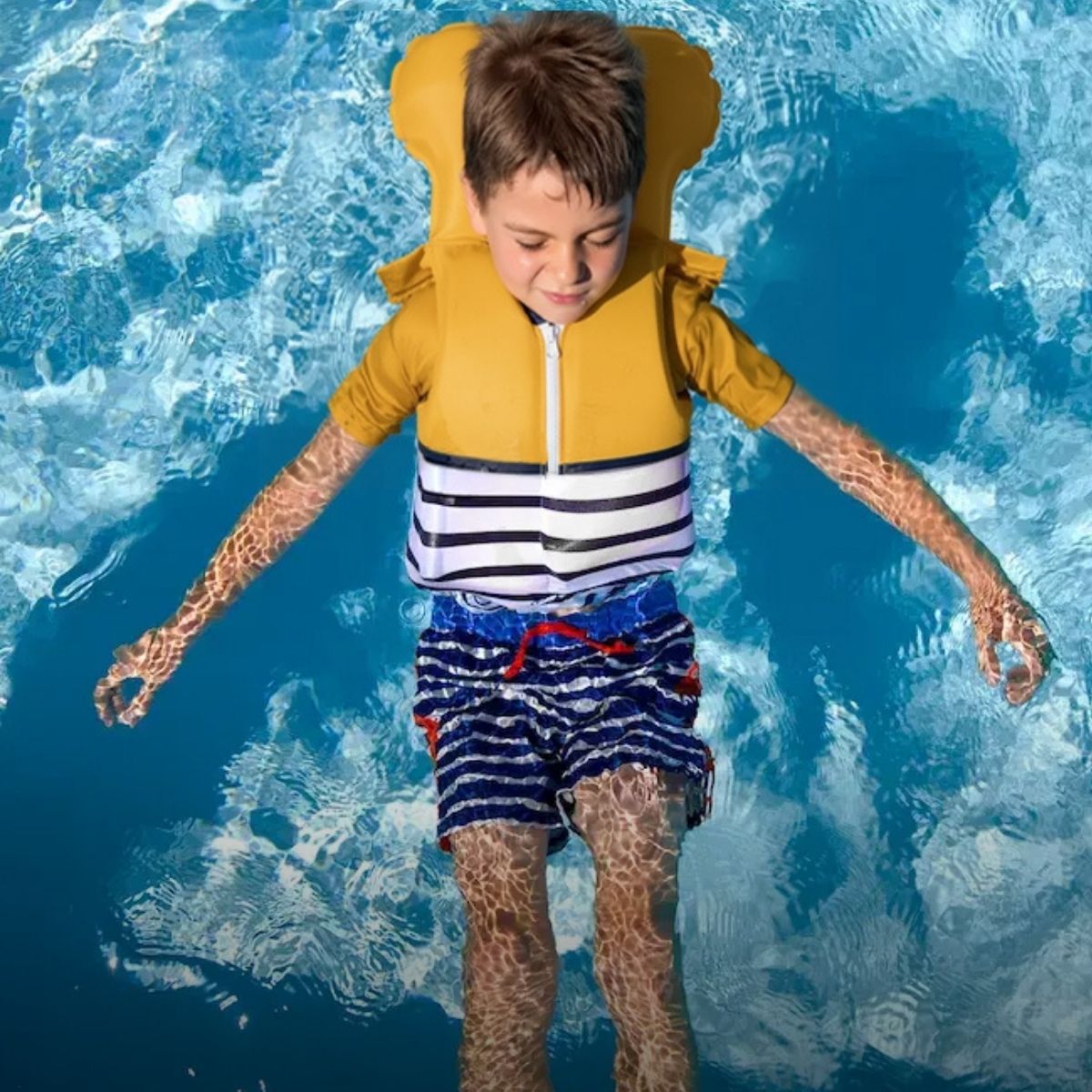
The gap: fewer than 60% consistently use swimming aids or buoyancy aids. Around four in ten parents and caregivers rely solely on supervision, swimming lessons and safety rules – without giving the child a passive safety buffer.
Most respondents believe children should be able to swim safely between the ages of four and seven. Until then, supervision alone is not complete protection. Children under five have the world's highest drowning rate – according to the WHO, this age group accounts for almost a quarter of all global drowning deaths. (WHO, Global Status Report on Drowning Prevention, 2024) A single moment of distraction is enough.
Knowledge and Training: How Large Is the Water Safety Gap?
Only around half of all respondents say they know with confidence how they would respond in a drowning emergency. A further 42% only partially know. 10% don't know at all.
The training picture is particularly striking: 64% of active water users have not attended a water safety training in more than five years – 16.7% have never attended one. The consequences are measurable: those who trained in the past year know how to respond in an emergency in 91% of cases. Those who have never trained: only 17% say they would know what to do. At the same time, according to DLRG data, the proportion of primary school children who cannot swim doubled from 10% to 20% between 2017 and 2022.
Table 3 – Last Swimming or Safety Training by Gender
| Last training |
Male |
Female |
| Less than 1 year ago |
23% |
17% |
| 1–5 years ago |
19% |
14% |
| More than 5 years ago |
46% |
48% |
| Never |
12% |
21% |
Base: 1,834 respondents, RESTUBE Water Safety Guide Study 2026.
Among women, the proportion who have never attended swimming or safety training (21%) is almost double that of men. Knowledge fades. Techniques you have never practised rarely work in an emergency. Water safety is not a state you reach once – it needs to be maintained.
The respondents' verdict on the system is clear: almost 80% believe water safety is not adequately covered in schools and the media. Only one in fourteen considers it sufficiently addressed. That is a sharp societal finding.
Five Conclusions for Safer Time on the Water
Knowledge protects – when it translates into behaviour. The data from the Water Safety Guide Study 2026 points to five conclusions relevant to everyone who spends time near water.
-
Overconfidence is the central risk. Those who consider themselves strong swimmers often skip protection. This applies especially to capable recreational swimmers who systematically underestimate the risks of currents, exhaustion and physical failure.
-
Buoyancy aids belong in your kit – not as the exception. Very good swimmers wear them most consistently – because they know what can really happen in the water. If you spend regular time near water, draw the same conclusion.
-
Recreational sports enthusiasts and anglers need more attention. They spend significant time at water without a club or course setting that builds a safety culture. Risk profile and safety behaviour don't line up.
-
Children need protective equipment, not just supervision. Supervision is essential, but it is not a substitute for close-body protection. Until children can genuinely swim safely, a buoyancy aid – alongside supervision and swimming lessons – is the decisive safety buffer.
-
Safety knowledge needs refreshing. A swimming certificate from childhood is not enough. Anyone who wants to be genuinely prepared practises regularly – rescue techniques, safety rules, self-rescue methods – and is ready to help themselves and others in an emergency.
Key Findings at a Glance
-
1,834 respondents from the DACH region, 82% from Germany
-
60% have already experienced a critical situation in the water
-
38% never use a buoyancy aid – only 16% always do
-
Experience paradox: Very good swimmers have the most critical incidents (73%) and simultaneously the highest consistent equipment use (23% always)
-
Anglers are an overlooked risk group: regularly at the water, frequent critical incidents, below-average equipment use
-
Children: supervision is widespread, protective equipment is not yet universal
-
Almost two thirds have had no safety training in more than five years – or never
-
79% believe water safety is not adequately addressed in society
- In Germany, 393 people drowned in 2025 according to DLRG data – 82% male, over 70% in lakes and rivers
Explore the full study with interactive data and charts on our Water Safety Guide Study 2026 page →
Sources
- DLRG – Deutsche Lebens-Rettungs-Gesellschaft (German Life Saving Society): Drowning Statistics 2025 (Press release March 2026) — presseportal.de/pm/7044/6232597
- WHO – World Health Organization: Global Status Report on Drowning Prevention 2024 (December 2024) — who.int/publications/i/item/9789240103962
- WHO – World Health Organization: Drowning Fact Sheet (updated December 2024) — who.int/news-room/fact-sheets/detail/drowning
- Federal Highway Research Institute (BASt): Bicycle helmet usage rates in Germany 2023 — bast.de
- Skiinfo.de: Ski helmet usage and helmet regulations in Germany — skiinfo.de
- RESTUBE Water Safety Guide Study 2026 – Raw data, n=1,834, DACH region, April 2026














 Swimming
 Stand Up Paddling
 Canoeing & Kayaking
 Motorboating
 On board
 Diving
 Fishing
 Snorkeling
 Casual beach days
 Professional Rescue
 River
River
 Lake
Lake
 Swimming Pool
 Sea
Sea
