North Sea Scenario: When Tides and Wind Make Surfing Dangerous
You are on the North Sea coast. It seems like an ideal day for surfing: moderate waves, good visibility, pleasant temperature. You enter the water at incoming tide. Conditions feel stable, maybe even relaxed. What you barely notice in this moment: the system you are moving in is already changing.
As the tide comes in, it is not just the water level that rises. A large-scale current develops, continuously transporting water landward. This movement is not locally visible like a wave, it acts broadly and constantly. At the same time, the coastline changes. Areas that were previously shallow or served as reference points slowly disappear under water. Sandbars that previously broke waves lose their effect - the waves become longer, faster, and reach you with more energy.
As you continue surfing, the wind gradually turns offshore, from land out to sea. This moment is critical, but frequently underestimated. Offshore wind smooths the water surface and creates cleaner waves - a condition that is attractive to many water sports enthusiasts. At the same time, it creates an additional force that is imperceptibly pushing you away from shore.

Now several factors are acting simultaneously:
- The tide is transporting large masses of water and changing the topography beneath you.
- The offshore wind is creating a continuous drift away from land.
- The changed water depth means waves break less early and retain their energy longer: they travel more steadily beneath you, carrying you further out step by step.
What you initially perceive as a slight change in position is in reality the beginning of a systematic shift. You are further out than you were just a few minutes ago, often without having consciously noticed it.
What Happens Physically With Tides, Wind and Waves?
In this situation, three processes overlap: First, the tidal current, which moves water on a large scale and generates lateral and directed currents - currents that move constantly in one direction over a certain distance. Second, wind drift, which acts particularly on the body and board at the surface. Third, the changed wave characteristics, which can carry you further out than under previous conditions. This combination means your effective position continuously moves away from shore, even when you are actively surfing or paddling.
The Critical Moment: When You Are Working Against the Forces
At some point you notice that the way back is getting harder. You have to paddle more than before just to hold your position. You may feel the first signs of fatigue. This is exactly where the critical phase begins. Many people now make the decisive mistake: They try to fight directly against all forces at once. The problem is that currents, wind, and waves act constantly while your strength fades quickly. The harder you fight against them, the faster you tire. Your technique gets worse, your movements become less efficient. Meanwhile, the distance to shore keeps growing.
What to Do When Caught in Currents, Wind and Tides
The most important step is to recognize the situation early - not when you are already exhausted, but as soon as you notice:
- You can no longer hold your position without effort.
- You are visibly drifting.
- The way back feels noticeably harder.
At this moment you need to change your strategy. Instead of working directly against the forces, the key is to use or avoid them. In practice, this means: don't move head-on against wind and current. Look for an angle where the forces are weaker. Moving sideways out of the main current is often far more effective than a direct route back.
At the same time, actively manage your energy. Short, controlled movements are more efficient than frantic paddling. The goal is to stay in control - not to force speed.
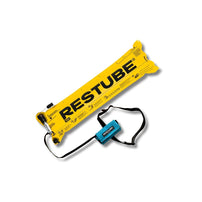
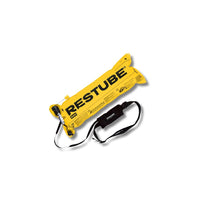
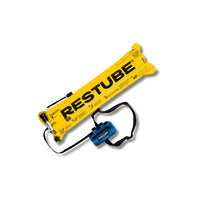
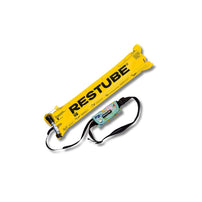
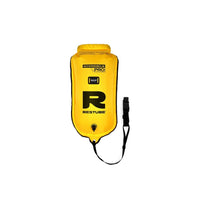
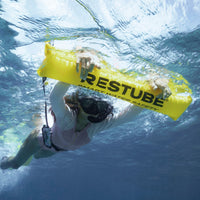
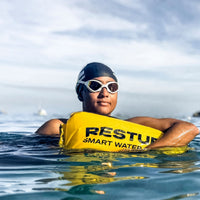
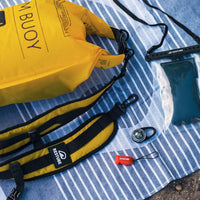
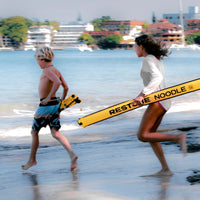
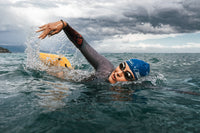
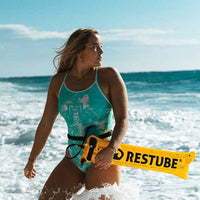
If you notice your strength fading or you can no longer control the situation, buoyancy becomes the decisive factor. If you are wearing a swim or life jacket, you already have that buoyancy with you. Without one, a system like the RESTUBE Safety Buoy can help in exactly this kind of situation. It stabilises your position in the water, reduces energy expenditure, and buys you time to orientate yourself, signal for help, or choose a new strategy.

Why Are Tides and Wind So Dangerous?
What makes this situation so dangerous is not a single factor, but the combination:
- The change happens gradually.
- Conditions initially seem positive: good waves, smooth water.
- The strain builds slowly.
- The critical point is often recognised too late.
This is exactly why tides in combination with wind are among the most frequently underestimated risks in coastal areas.
"Tides are not a static piece of information like 'ebb' or 'flow'. They are a dynamic process that changes the entire environment. Safety does not come from knowing that it is high tide - it comes from understanding what that specifically changes and how to respond to it." ~ Christopher Fuhrhop, Founder RESTUBE
The Best Tide Apps for Water Sports Enthusiasts: Surfline, Windy & Co.
Anyone who wants to truly assess tides cannot do without digital tools today. Modern tide and surf apps deliver precise data on water levels, currents, wind, and waves - often in real time.

Here are the most important apps that even professionals rely on:
-
Surfline: One of the most widely used apps for surfers worldwide. It combines tides, waves, wind, and live webcams for thousands of spots. Ideal for not just reading conditions, but understanding them visually.
-
Windy: Extremely powerful for wind, weather, and current visualisation. Perfect for understanding how wind and tides interact, especially in coastal regions.
-
Nautide: Focused on tides: it delivers precise water levels, tidal curves, and astronomical data for thousands of coastal stations worldwide.
-
Tide Charts: Stripped back to the essentials: it shows high and low water clearly and simply, along with their timing. Ideal for quick decisions on the spot.
Tide apps are no substitute for experience, but they are one of the most powerful tools for recognising risks early. Those who understand and use them correctly often spot dangers before they even develop. As a beginner, it is also worth orienting yourself around experienced water sports enthusiasts. If you find yourself alone in the water, that in itself can be a clear warning sign.
Hydrodynamics: The Key Takeaways
Water is not unpredictable - it follows its own rules. We just need to learn, observe, and respect them. Those who understand hydrodynamics can recognise early what is coming: a shift in the wind, a changing wave direction, a strangely calm spot in the sea that reveals more than it shows. This awareness is part of true water competence and the foundation for safe behaviour in, on, and around the water.
Safety guidelines for hydrodynamics
-
Water is never still. Every movement has a cause and an effect.
-
Observe before you act. Currents, wind, and the shape of the terrain - they reveal a lot.
-
Don't fight the water. Use its energy rather than working against it.
-
Stay calm, stay aware. Panic is more dangerous than any wave.
-
Knowledge protects. The more you understand about water, the safer you will feel.





















 Swimming
 Surfing
 Kitesurfing
 Stand Up Paddling
 Windsurfing
 Wingfoiling
 Motorboating
 On board
 Casual beach days
 Fishing
 Snorkeling
 Triathlon
 Sea
Sea
 River
River
 Canal
Canal


