RESTUBE: What got you into open water swimming?
Nathalie: "My story starts very early. I learned to swim at five, just in a regular swimming course, although I’d actually had my first swimming experiences on holiday. I really loved swimming and got better quickly. I then joined a swimming club and soon swam my first competitions – back then 25 m freestyle, so just one length. I've stayed with swimming ever since. But after my whole childhood and youth in the pool, there came a phase when I lost the fun in swimming and was seriously thinking about quitting the sport altogether. Luckily, my parents then gave me Lynne Cox's book Swimming to Antarctica, in which she describes in detail how she swam the English Channel. It inspired and fascinated me so much, and I saw so many parallels to myself. My goal in life back then became to swim the English Channel, and that's how it all began."
RESTUBE: Where does your passion for open water swimming come from?
Nathalie: "I think it grew over many years. I've loved being in the water since I was little. I loved the water, nobody could ever get me out, and over the years that feeling only got stronger. I looked forward to every training session. Every day, I knew it would be the best part of my day.
I'm so glad and proud that I stuck with it all my life and never gave up, because today I get to experience beautiful moments out at sea. Being alone with myself and my thoughts for so many hours is something very special. My passion for the sea is about freedom: being out there on your own, with no distractions, just you and your thoughts. You don't find that anywhere in today's world. It's also about going to your limits, pushing your body and seeing what we're capable of when we focus 100 percent on one thing."
Facts about Nathalie Pohl:
-
Born in Marburg, Germany, in 1994
-
First German woman to finish the Ocean's Seven, the seven toughest ocean straits in the world
-
Swam from Frankfurt to Cologne: 200+ km through the Main and Rhine in four days (2026, relay)
-
Author of Im Meer bin ich zu Hause (2024)
RESTUBE: What makes open water swimming special?
Nathalie: "There are so many special things. I think the biggest difference is that we now swim in nature, whereas before, in the pool, everything was planned. I knew, for example, that I'd start on Sunday at 1 pm, swim for a set time, and then it was over. Out there, nothing can be planned.
I depend on so many factors I can't plan in advance: wind, currents, all these things I have no influence on, and that's what makes it so special. It's also very challenging, so you have to be extremely fit mentally for this sport. Then there are the endless distances I swim today, and water temperatures that are sometimes below 13 °C (55 °F). You really see how your body changes and adapts and what it's capable of, and that's what's special, too."

RESTUBE: What are the official Ocean's Seven rules?
Nathalie: "The official Ocean's Seven rules are: no wetsuit. We're allowed a normal swimsuit, goggles and a swim cap, and that's it. The support boat sets the course, and we're not allowed to touch the boat. We can stop to drink, but the bottle is thrown to us, and that's it. Otherwise, we have to swim non-stop from A to B. Those are the Ocean's Seven rules. Once you've completed all seven, you've swum the Ocean's Seven."
RESTUBE: What are the dangers?
Nathalie: "There are many. The biggest danger is the cold and hypothermia, meaning severe cooling of the body, when you spend so long in such cold water. Then there's general exhaustion when you swim for up to 15 hours. And there's the unpredictability of the weather, which can change very, very fast. In the Cook Strait, for example, it was like swimming in a pool for six hours. Then the wind and everything else changed, and within ten minutes there were three-metre (10 ft) waves and I was fighting everything.
The currents out there are also unpredictable, especially for people who don't swim competitively. I would never swim anywhere without knowing exactly what the conditions are. That can become life-threatening."
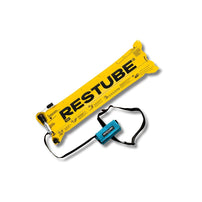
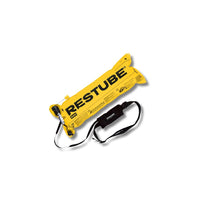
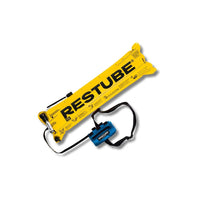
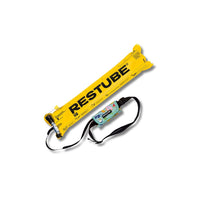
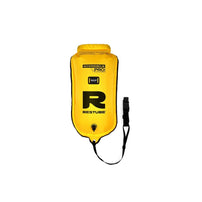
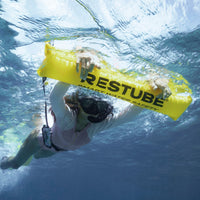
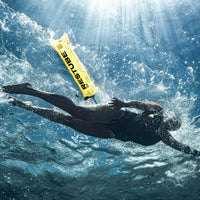
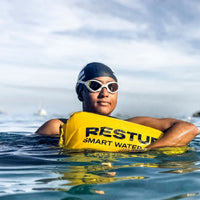
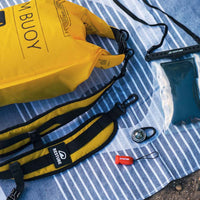
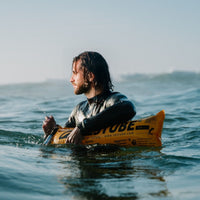
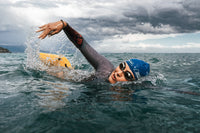
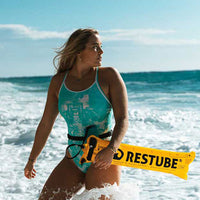
"Despite the escort boat, you swim out there alone. RESTUBE Safety Buoy helps me keep my focus while swimming. The super small Safety System has no flow resistance and is weightless in the water. A pull on the trigger inflates the yellow Safety Buoy in seconds, which gives me an even better feeling." ~ Nathalie Pohl, extreme swimmer & Ocean's Seven finisher
RESTUBE: How do you prepare for these dangers?
Nathalie: "All my life I've prepared for the worst. When I knew, for example, that the water in the North Channel would be 13 °C (55 °F) or colder, I did everything I could to get through it. I put on body weight to protect myself a little, because we're not allowed to wear wetsuits. I also expected to be stung by an extremely venomous jellyfish at some point, day or night, like the Portuguese man o' war in Hawaii. Of course, you can't really prepare for that. But playing these scenarios through in your head and preparing for every possible situation down to the smallest detail is something I've always done. It's very important for minimising the risk."
RESTUBE: What does your preparation look like in detail?
Nathalie: "It really differs from swim to swim. I train up to six hours a day in the pool and do strength training twice a week to build my specific strength. Then, of course, a lot of mental training. Studying the swim that lies ahead of me in detail is also very important. We prepare very differently depending on how long the swim is and how cold the water will be. For cold water, I sometimes prepare with ice baths. To prepare for the North Channel, I sat in an ice barrel at 5 °C (41 °F) for up to an hour. The best preparation, of course, is always to train in the local conditions. That helps enormously."

Frankfurt to Cologne: In August 2026, Nathalie Pohl swam more than 200 km in four days through the Main and Rhine, in a relay team that took turns about every two hours. The challenge raised money for swimming lessons for children.
RESTUBE: How do you deal with challenges?
Nathalie: "I don't think there's one way to deal with them, but I've always learned to accept challenges as they come. When conditions get worse, the current changes or a jellyfish stings me, I can either give up or try to keep going as long as possible. That's what I've always tried to do, right up to the point where it just wasn't possible anymore, where my body told me: this is it.
I'm very ambitious. I believe you can only complete these challenges if you want them 100 percent. The Ocean's Seven was my absolute dream in life. I felt like I dreamed about it every night. When you have a dream that big, you're ready to give everything for it. Out there, you only have two options: get on the boat, or accept it. I always tried to accept it and pushed my body to its absolute limit. But I always had a team with me that knew when my limits had been reached.
That's extremely important: having a team, people who know you 100 percent and can tell when the limit has been reached, because at some point out there you can no longer make that decision yourself. That's what makes the team so important."
RESTUBE: What safety precautions do you take before an open water swim?
Nathalie: "For me, safety precautions are the most important thing, and I always check everything before a swim: Are the lights on the boat? Do I have enough distance from the boat? What will the conditions be like? I'm someone who likes to check everything ten times. Anything we can rule out in advance is good, and that's what we try to do.
Even as a recreational swimmer, you should always look very closely at the waters you swim in and never underestimate them. It can become life-threatening very quickly, and you can't see what's beneath you. Currents can be anywhere. That's why you should never go into open water alone. Always go with someone, or even with a boat or kayak. Never go out alone."

RESTUBE: What role does safety play in open water swimming?
Nathalie: "Safety plays a huge role in open water swimming. Especially in the sea, it's so important to learn about the conditions beforehand, and you really mustn't underestimate them, no matter how well you swim. The cold is another factor I would never underestimate in my entire life. That's why it's so important to be safe out there. And that's where RESTUBE is really perfect: you carry a small buoy that doesn't restrict your movement, and you still know that if something happens, you're safe and not in danger.
Far too many people underestimate how dangerous it can be out there. They think, 'I'm a good swimmer,' but that has nothing to do with it. When a current comes, you can be the best swimmer in the world and you still won't make it. That's why it's so important to think about safety in advance, so you won't regret at the end having done something without sorting out your safety first."