What Is Assisted Rescue?
Assisted rescue covers all the actions a second person takes to actively step into the rescue process – to save someone in distress from drowning, or to interrupt a drowning process that has already begun. It's a core part of the Drowning Chain of Survival and one of the most demanding areas of water rescue. Unlike self-rescue, assisted rescue means considering not only the needs of the person in distress, but also your own safety and the dynamics of the environment. Modern water rescue therefore treats assisted rescue not as a spontaneous act of help, but as a structured decision-making and action process grounded in emergency medicine, safety science, human factors research, and rescue tactics.

Why Rescuers Put Themselves at Risk
As described in the article Water Rescue Without Risk, a rescue attempt can only succeed if the rescuer stays capable of acting – a principle that's often ignored in real emergencies. When family members or bystanders jump straight into the water without training or rescue equipment, the worst-case result is what's known as double drowning, where both the person in distress and the rescuer end up drowning.
The reason lies in the drowning process itself: as oxygen deprivation increases, the brain loses its ability to act purposefully, and the body switches to pure survival reflexes, trying to keep the airway above the water's surface. People in this state instinctively grab onto anything within reach – including a rescuer who gets too close. This is part of the already familiar Instinctive Drowning Response and happens regardless of age or swimming ability. Panicked clinging should never be mistaken for intentional behavior – but it can still be fatal for the rescuer.
Self-Protection as the Top Priority
This is exactly why the internationally recognized principle of self-protection exists: a rescuer must always prioritize their own safety over the urge to rescue quickly. The logic is simple: a rescuer who gets into trouble can help neither themselves nor the person they set out to save, and ties up additional rescue resources. Protecting the rescuer isn't just about their own safety – it also increases the odds of a successful rescue overall. In practice, this principle is applied worldwide through a staged escalation model: Reach – Throw – Wade – Row – Go. This order isn't arbitrary – it's based directly on the rescuer's increasing level of risk at each stage. Each stage is only abandoned once the previous one proves unworkable or isn't technically possible.
Rescue Equipment and Approach Tactics: The Right Way to Reach Someone in Distress
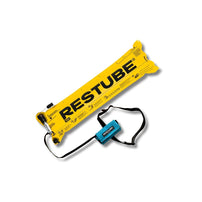
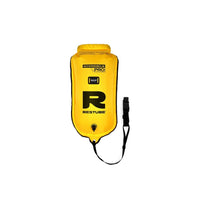
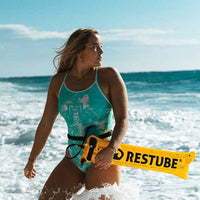
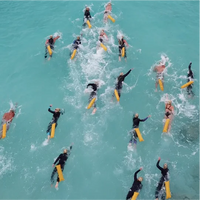
Rescue equipment deserves particular attention here. While public perception often focuses on a rescuer's physical fitness, the evidence shows that using the right equipment matters far more than raw swimming speed. A rescue device serves several functions at once:
- It gives the person in distress additional buoyancy
- Reduces their physical strain
- Creates distance between rescuer and patient
- Gives the rescuer themselves extra stability
This combination explains why professional water rescuers avoid a swimming rescue without proper equipment whenever possible.
Beyond the right equipment, how you approach the person in distress also has real tactical weight. International training standards recommend avoiding a direct frontal approach where possible, instead coming in slightly from the side or behind – this lowers the risk of uncontrolled grabbing. It also helps to establish verbal contact before physical contact: calm, short, clear instructions can help calm the situation. But as panic and oxygen deprivation increase, verbal communication becomes far less effective – it never replaces a rescue device, only supplements it.
A rescue device can reach the person in distress in one of two ways:
- Thrown, from a safe distance
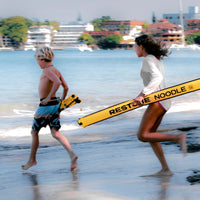
- Carried out and handed over in direct contact

The throw technique is always the first choice, since the rescuer stays outside the danger zone. But it requires the person in distress to still be conscious and able to grab the device themselves. If that's no longer the case, or if distance, wind, or current can't be safely bridged, the hand-delivery technique becomes necessary: the rescuer brings the device directly to the person. One important rule applies here: the rescue device should always be positioned between rescuer and person in distress – it acts not just as extra buoyancy, but as a physical barrier against uncontrolled clinging.
Environmental Conditions and Rip Currents
Water rescue rarely happens under simple conditions. Currents, waves, surf, boat traffic, cold water, poor visibility, or darkness fundamentally change the demands of any rescue. Rivers are especially dangerous: even current speeds under one meter per second generate forces strong enough to make standing or swimming safely very difficult. Weirs or bridge piers also create dangerous flow patterns – such as backwash, where water flows back behind an obstacle and can trap someone there, or undertow, which pulls a person beneath the surface. Modern water rescue therefore always begins with an assessment of the environment before any rescue action starts.
The coast has its own rules too. Surf zones are shaped by shifting wave forces and strong rip currents – powerful currents caused by water flowing back out from the surf zone, which can sweep even strong swimmers away from shore at high speed. They're one of the leading causes of fatal swimming accidents worldwide. For assisted rescue, recognizing these currents early is critical: swimming directly against a current quickly leads to exhaustion and raises the risk for both rescuer and person in distress.
Behavioral Tendencies and Stabilizing After the Rescue
Helpers under stress tend toward what's known as Action Bias – the tendency to act visibly and immediately rather than choosing the safest strategy. On top of that, time pressure often causes tunnel vision: attention narrows entirely onto the person in distress, while other dangers – such as currents or the rescuer's own exhaustion – go unnoticed. Professional training replaces these intuitive reactions with structured decision-making, since it's the safest strategy, not the fastest one, that saves the most lives in the long run.
Once the person in distress has been reached, the priority is: stabilize first, then bring to shore. Additional buoyancy often improves breathing right away. Only after that comes the transport to land or to a rescue vehicle – depending on the water, the equipment, and the person's condition – while airway, consciousness, and circulation are monitored continuously. Assisted rescue therefore doesn't end when the person is reached; it ends only once they're safely handed over to emergency services.
Conclusion
Assisted rescue is a highly complex process where
- medical knowledge
- tactical skill, and
- psychological understanding
come together. Successful water rescue doesn't depend on physical strength – it depends on structured situational assessment, consistent self-protection, and the right use of rescue equipment. The guiding principle isn't "as fast as possible," but "as safe as necessary."
















 Swimming
 Surfing
 Kitesurfing
 Stand Up Paddling
 Windsurfing
 Casual beach days
 On board
 Snorkeling
 Rowing
 Canoeing & Kayaking
 Fishing
 Professional Rescue
 Stream/Creek
 River
River
 Canal
Canal
 Sea
Sea
 Swimming Pool
 Lake
Lake
 Pond
Pond

